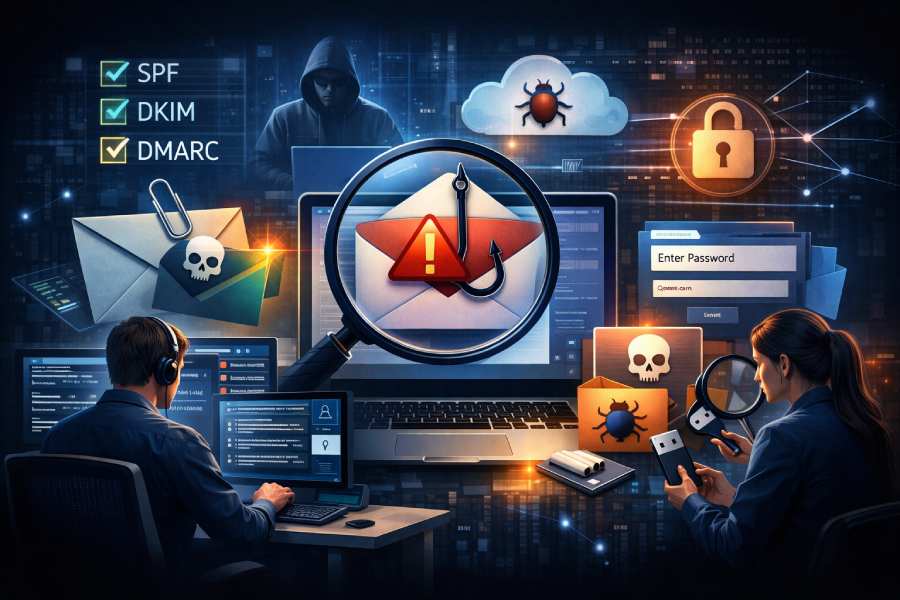
Phishing prevention in 2026 demands renewed security awareness because adversaries blend social engineering with generative AI to industrialize online fraud. Attackers automate phishing campaigns, personalize messages at scale, and mirror brand voice, turning ordinary phishing emails into highly convincing, deceptive emails. Effective phishing attack prevention now hinges on layered security measures, robust phishing detection,
Microsoft Defender for Office 365 is the cloud-native layer of professional-grade protection that safeguards email and collaboration data across Microsoft 365. It delivers advanced virus protection and phishing defenses for Outlook, plus malware and ransomware controls for OneDrive, SharePoint, and Microsoft Teams. Unlike a traditional antivirus that runs only on endpoints, it provides online
Modern attackers continue to pivot faster than controls evolve, which is why O365 phishing protection remains a top priority for Office 365 security teams in 2026. Business Email Compromise (BEC) campaigns now blend executive impersonation with invoice tampering and supplier fraud. MFA fatigue and push-bombing bypass weak sign-in habits, while QR code “quishing” evades
Phishing attacks persist because social engineering reliably exploits human trust, brand familiarity, and urgency. Threat actors evolve lures faster than signature-based defenses, leveraging brand impersonation (often Amazon and other consumer brands), email spoofing, website spoofing, and malicious links to drive credential theft, account takeover, and business email compromise (BEC). Even with strong email security,
The phishing ecosystem has shifted from opportunistic spam to targeted, multi‑channel email attacks driven by generative AI and criminal marketplaces. Threat actors now pair convincing social engineering with compromised infrastructure to deliver machine-speed attacks that outpace legacy controls. As organizations accelerate adoption of cloud platforms and distributed work, the attack surface grows, and the
Targeted attack campaigns increasingly arrive as well-crafted emails that look routine but are engineered to mislead. In modern cybersecurity programs, email remains the most common doorway to a phishing attack that leads to a data breach, ransomware deployment, or silent information theft. Analyses from IBM’s X-Force Threat Intelligence Index, Barracuda researchers, and the Federal
The Report Phishing and Report Message add-in experiences let users flag fake emails for phishing reporting and training within Office 365. They streamline submission to Microsoft and your SOC, helping Microsoft Defender for Office 365 learn from false positives and false negatives while surfacing user-reported messages in your Security Dashboard. In modern Outlook clients,
Credential stuffing is no longer a “bad week” event. For many teams, it is background noise that spikes without warning, blends into normal user behavior, and quietly drains time from higher-value security work. The hardest part is not knowing it exists, along with the awareness of phishing attacks. It is knowing it exists, and still
Spear phishing succeeds because it blends social engineering with business realism. Cybercriminals mine LinkedIn org charts, press releases, and leaked credentials from a prior data breach to craft personalized emails that look routine: a vendor remittance, a benefits portal update, or a CFO approval.
When impersonation protection seems ineffective in Office 365/Microsoft 365, the root cause is usually a gap in anti-phishing policies, scope, or mail flow. Modern phishing attacks blend display-name deception, lookalike domains, and compromised partner accounts to evade basic filters. Microsoft Defender for Office 365 adds machine learning-based detection, spoof intelligence, and first contact safety
Phishing email analysis is the systematic examination of suspicious messages to identify, validate, and contain phishing attacks before they lead to compromise. It combines email header analysis, email content examination, and artifact inspection to strengthen email security and improve threat detection against evolving cybersecurity threats.
Online payment gateway integration with CRM turns your multipurpose platform allowing you to manage customers and receive payments from a centralized place. CRM systems are implemented into companies to enable them to generate leads, and revenue, and automate marketing workflows. Payment gateways are not designed only for transaction processing but also for workflow enhancement. Combining
Phishing emails are still the most common entry point for a phishing attack, because a convincing phishing message can fool even vigilant users. Cybercriminals craft urgent email lures with a fake “urgent call to action,” embed suspicious links to fake websites, and attach unexpected attachments that deliver malware or ask for personal information.
A website that frequently goes offline disrupts both visitors and business goals. Reliable web hosting forms the foundation for an online presence that users and owners can trust. Many site owners search for answers when their pages suddenly stop working. Knowing why problems arise and how to solve them prevents repeat trouble and missed opportunities.
A zero-day attack occurs when threat actors exploit a previously unknown vulnerability in software, hardware, or firmware—one for which no patch or fix has been made available by manufacturers or vendors. These attacks are especially dangerous because organizations lack prior knowledge and defensive measures against them, allowing adversaries to bypass traditional network security systems
Phishing attacks have evolved into one of the gravest cyber threats affecting businesses and individuals. As enterprises increasingly rely on cloud-based communication platforms like Office 365 and G Suite, the vectors for phishing attacks become more sophisticated and technically advanced. Cybercriminals exploit these channels, targeting business-critical data and leveraging techniques such as email impersonation,
State-sponsored IT fraud is a real threat, and the recent disclosure by Amazon further proves the point. The e-commerce giant has barred a whopping 1800 DPRK IT operatives from joining the company since April 2024. This cyber incident is a staggering reminder of how persistently bleak the situation can be when it comes to
Spear phishing remains one of the most sophisticated and damaging forms of cyber threats facing organizations and individuals today. As cyber criminals continue to refine their tactics, it becomes critical for companies and employees alike to stay ahead of these targeted attacks. This article explores the unique nature of spear phishing, details how these
Phishing emails remain the most prevalent vehicle used by cybercriminals to compromise both consumer and enterprise accounts. Using highly deceptive methods, attackers craft messages designed to steal your personal information, bank information, and credentials such as passwords or membership card details. Their objective is often identity theft or financial gain, and the techniques they
We use cookies on our website to give you the most relevant experience by remembering your preferences and repeat visits. By clicking “Accept”, you consent to the use of ALL the cookies.
This website uses cookies to improve your experience while you navigate through the website. Out of these, the cookies that are categorized as necessary are stored on your browser as they are essential for the working of basic functionalities of the website. We also use third-party cookies that help us analyze and understand how you use this website. These cookies will be stored in your browser only with your consent. You also have the option to opt-out of these cookies. But opting out of some of these cookies may affect your browsing experience.
Necessary cookies are absolutely essential for the website to function properly. These cookies ensure basic functionalities and security features of the website, anonymously.
Cookie
Duration
Description
cookielawinfo-checkbox-analytics
11 months
This cookie is set by GDPR Cookie Consent plugin. The cookie is used to store the user consent for the cookies in the category "Analytics".
cookielawinfo-checkbox-functional
11 months
The cookie is set by GDPR cookie consent to record the user consent for the cookies in the category "Functional".
cookielawinfo-checkbox-necessary
11 months
This cookie is set by GDPR Cookie Consent plugin. The cookies is used to store the user consent for the cookies in the category "Necessary".
cookielawinfo-checkbox-others
11 months
This cookie is set by GDPR Cookie Consent plugin. The cookie is used to store the user consent for the cookies in the category "Other.
cookielawinfo-checkbox-performance
11 months
This cookie is set by GDPR Cookie Consent plugin. The cookie is used to store the user consent for the cookies in the category "Performance".
viewed_cookie_policy
11 months
The cookie is set by the GDPR Cookie Consent plugin and is used to store whether or not user has consented to the use of cookies. It does not store any personal data.
Functional cookies help to perform certain functionalities like sharing the content of the website on social media platforms, collect feedbacks, and other third-party features.
Performance cookies are used to understand and analyze the key performance indexes of the website which helps in delivering a better user experience for the visitors.
Analytical cookies are used to understand how visitors interact with the website. These cookies help provide information on metrics the number of visitors, bounce rate, traffic source, etc.
Advertisement cookies are used to provide visitors with relevant ads and marketing campaigns. These cookies track visitors across websites and collect information to provide customized ads.